My Cursor Stats: What a Year of AI-Assisted Building Really Looks Like
A reflection on what my Cursor stats reveal about how AI changes building, thinking, and shipping.
I didn’t plan to track my Cursor usage obsessively. But when I looked back at my stats, they told a surprisingly clear story — not just about how much I used an AI editor, but how my way of building, thinking, and shipping software has changed.
This post is a reflection on that journey.
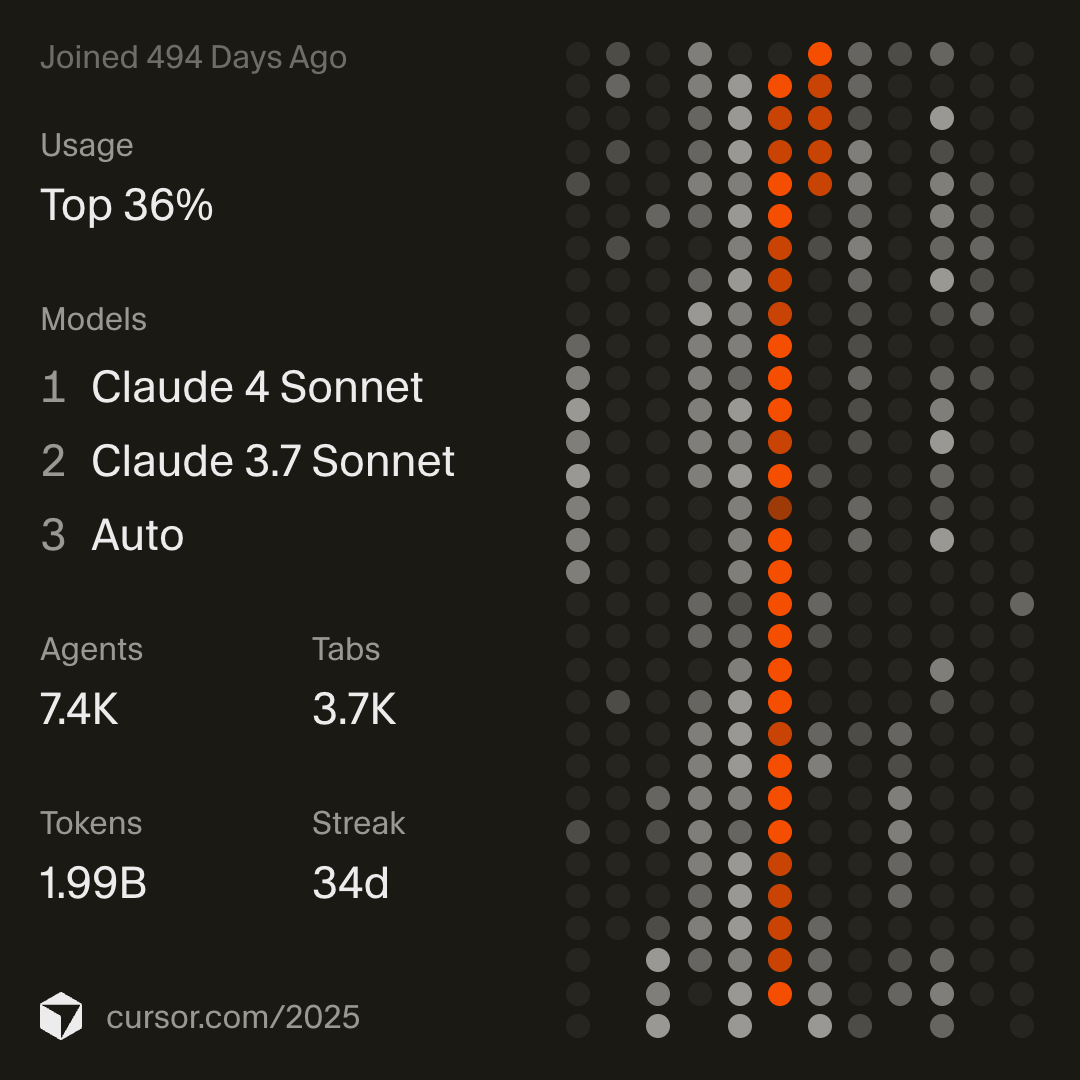 Snapshot from my Cursor 2025 stats.
The numbers (at a glance)
- Joined: ~494 days ago
- Usage percentile: Top 36%
- Most used models:
- Claude 4 Sonnet
- Claude 3.7 Sonnet
- Auto
- Agents created: 7.4K
- Tabs opened: 3.7K
- Tokens consumed: 1.99B
- Current streak: 34 days
At first glance, this looks like “heavy usage.” In reality, it reflects something more structural.
Cursor is not an editor — it’s an operating system for thinking
The most misleading metric here is tokens.
1.99B tokens doesn’t mean I typed a lot. It means I externalized thinking at scale.
Cursor became:
- A design reviewer
- A senior engineer pair
- A documentation engine
- A ruthless simplifier
- A planning partner
I stopped asking “how do I write this?” and started asking “what is the cleanest system here?”
That shift compounds.
Why Claude Sonnet dominates my usage
I consistently gravitated toward Claude Sonnet models — not because they’re flashy, but because they’re predictable under pressure.
What mattered most:
- Long-context reasoning
- Calm refactoring
- Structured explanations
- Lower hallucination rate when systems get complex
For architecture, refactors, and multi-file reasoning, reliability beats cleverness.
7.4K agents ≠ experiments — they’re reusable brains
Agents weren’t disposable prompts. They evolved into:
- “Golden path” enforcers
- Planning agents
- Code reviewers
- Migration assistants
- Documentation generators
Each agent encoded a standard I didn’t want to renegotiate every time.
This is the real unlock:
You don’t scale productivity by working faster.
You scale it by making good decisions cheaper.
Tabs, context, and the end of cognitive thrash
3.7K tabs sounds chaotic.
In practice, Cursor reduced context switching:
- Specs live next to code
- Design docs evolve with implementation
- TODOs are embedded in execution
The editor stopped being a place where work happens, and became the place where work is decided.
The 34-day streak is the most important metric
Not tokens. Not models. Not percentile.
Consistency.
A daily streak means:
- Small, compounding improvements
- No “big bang” rewrites
- Continuous refactoring of both code and thinking
This is how real systems — and careers — are built.
What changed most for me
Before Cursor:
- I optimized for correctness
- I hesitated before starting
- I over-planned to avoid rework
After Cursor:
- I bias toward action
- I prototype aggressively
- I refactor without fear
The cost of being wrong dropped dramatically. That changed everything.
Final thought
These stats aren’t about flexing usage. They’re a snapshot of a deeper transition:
From executing tasks
to designing systems with AI as a first-class collaborator.
Cursor didn’t make me faster. It made me more decisive, more structured, and more ambitious.
And that’s the kind of tooling that actually compounds.